2008-10-06

Legal consistency

Some time ago I asserted that American court opinions "are fairly accessible once one learns a few key words and turns of phrase". Suddenly I begin to doubt that.

In EEOC v. Lee's Log Cabin (7th. Cir, 2008-10-06) I read this marvellous piece of logic:

The dissent also asserts that "[i]t is undisputed that at all relevant times, Stewart was not only HIV positive . . . but she also had AIDS. So the allegation in the complaint that Stewart was 'HIV positive' is consistent with the fact that she has AIDS." Dissent, at p. 18. No, it's not, but the opposite is true. That is, an allegation that Stewart has AIDS is consistent with an allegation that she was HIV-positive, but not vice versa. If a person has AIDS she is necessarily HIV-positive; but a person who is HIV-positive does not necessarily have AIDS.
(footnote 3). In the kind of logic I was taught, "consistency" between two propositions means that it is conceivable that both can be true at the same time, or (more syntactically) that assuming both will not let you derive a self-contradiction. This is a symmetric notion. It makes no sense to assert that A is consistent with B yet B is not consistent with A.

I wonder whether there is a particular legal meaning to "consistent" which is different enough from the logical one to make the above quote senseful.

2008-08-23

More precise than a million monkeys with typewriters

Ferdinand Foch is remembered for remarking, when the Treaty of Versailles was signed, that it was "not a peace but a 20-year armistice". This was eerily prophetic – he was right to within a handful of months. Foch must have had an unusually precise sense of the forces that make history go.

Or did he? I wonder how many would-be prophets characterized the treaty as an armistice for 10, 15 or 25 years, and were quietly forgotten by history.

It's easy to pick successful prophecies when you're allowed to wait until they come true before you decide which prophecies to point to.

2008-08-17

Why copyright is doomed

In the beginning there was no copyright.

Books were written (and music composed) by men of independent means, or by talented men sponsored by princes and nobles, or by scholars or clerics who were fortunate enough to have the power to decide that writing a treatise on this or that just happened to be part of their own duties. Somehow world literature got along.

Then somebody invented the printing press. The press, together with other technological advances during the 1400s, made mass production of printed books a feasible alternative to hand copying of manuscripts. And this changed everything.

First and foremost, printing books is a capital-intensive undertaking. In addition to the cost of the printing press and its various paraphernalia, setting type by hand is slow and costly. It makes sense to analyze the typesetting cost as capital rather than labor, because once the type is set, you can print copies of the book very cheaply. You can make your customers pay quite a bit more than your marginal cost for each item you sell, which will allow you to break even in the end. And the customers are not going to care whether you've broken even or not, so you can still charge the high price after you break even. If there's enough demand for the title, printing books can be quite a profitable business.

Now, printers who choose to print books that turn out to be popular become rich; printers who choose badly do not. If we assume that the popularity of one title over another is due to some special talent or effort expended by its author, it begins to look quite unfair that the printer should become rich because of them and the author get nothing. That is what the first copyright laws set out to remedy, after the changes wrought by Gutenberg had had a few centuries to sink in.

Actually, it was a bit more complex than that. Publishers – who around this time were emerging as a separate trade of funders and distributors of books – also benefited from copyright: Regulation of who could print what reduced the risk that another publisher would start printing the same book, leading to a price war (which would lose money for both printers as the the price per copy dropped towards the marginal production cost). But the moral justification for having a copyright system in the first place was that it let authors get a cut from the profit when the quality of their works became the foundation of somebody else's business.

During those same centuries, medieval religious drama gave way to professional theatre, and instead of semi-improvised lines that changed with time according to audience reactions and the actors' own wit, plays came to have written-down scripts authored by named playwrights. Theatre was now a business, and a company could make a profit with a good performance of a good play – and thanks to the printing press, the playwright need not be affiliated with the theatre company.

In music, partly in response to the demands of theatre, ensembles grew in size and complexity – beyond the point where the performance could be structured by oral agreements and remembered tunes. Music notation expanded to meet the needs of orchestrally scored music. Eventually the public concert where professional orchestras performed for paying audiences was invented. Having a good work by a recognized composer on the billboard certainly helped draw in those paying audiences.

Playwrights and composers must now suffer that not only could publishers make a business of printing their work, companies and orchestras could make a business of performing them. In response, copyright expanded to cover "public performances" in addition to simply the making of physical copies.

As I have insisted above, the moral purpose of copyright was still to save creators from the indignity of seeing somebody else build a profitable business upon their work without getting a share of the success themselves. But as a side benefit, creators who did create successes got an income source and the opportunity to quit their day jobs and create yet more successes. This benefits society as a whole. It was seen as an independent motive for copyright as early as 1787, when the drafters of the American constitution allowed for federal copyright legislation "to promote the Progress of Science and useful Arts".

Sound recordings were invented in the late 1800s and quickly integrated into the basic structure of copyright. They fit well there, because it requires specialized and expensive equipment to manufacture records, and large specific costs to prepare a recording for being mass produced – exactly the qualities that made copyright the right legal tool for printed books centuries earlier. As for books, creators of successful records have been able to quit their day job, sometimes spectacularly so.

Movies also got copyright. Again, production of film prints is a specialized commercial operation, and public performances is usually organized by businesses too. This fits the philosophical framework of copyright fairly well – though in comparison to a novel or a symphony, which are usually the work of an individual genius, creating a movie is quite a team effort. Copyright fairly easily let itself be extended too deal with large team efforts.

In each of these successful cases, copyright has felt like a right and just tool, because the activity being regulated – whether printing a book, performing an opera, stamping a record, or showing a movie – was naturally and necessarily a commercial undertaking. Done by a business. For a profit, which it is only reasonable to share with a creator.

Well, well, well. Guess what is not true anymore?

We see the underlying assumption break down most clearly for recorded music. For at least a decade there has been no practical reason why copies of sound recordings need to be made by a business rather than by private individuals. The technology is cheap and ubiquitous, and the shift in public perception of copyright has been quick and pervasive. Very few people today really feel that it is morally wrong to create an unlicensed copy of a commercially released song they like. Those of us who nevertheless refrain from doing so do it for the warm fuzzy righteous feeling of complying with the law even when the law is unreasonable.

Movies are not far behind music in this development. Many kinds of books still hold out, because people like the feeling of real bound paper books better than reading from a computer screen. But if print-on-demand hardware becomes ubiquitous enough that bound paper books are not made by specialized businesses anymore (or if really acceptable ebook readers emerge), I predict that the respect for copyright of books will go the same way as that for music. And, of course, already some kinds of non-fiction books are dying breeds, being replaced by free internet versions.

Music and movie publishers everywhere know all this, and are understandably all up in arms. Their response so far is threefold:

  1. Try to put the genie back into the bottle. Have copying technology outlawed or forcibly crippled. If this prevents amateur artists from creating their own works that may compete with commercial offerings, then so much the better.

    If successful this would lead to a nightmare world, but I don't think our politicians are that stupid. We have Vernor Vinge, Cory Doctorow and the EFF to explain why this shouldn't succeed; overall they do it well enough that I think it won't.

  2. Lobby legislatures to introduce ever more draconian laws to enforce copyright. Hope that you can bludgeon people into following rules out of fear that they won't follow out of fairness.

    At best, this is a short-term stopgap. At worst ... well, it doesn't really seem to have the desired effect out in the real world, does it? If anything it seems to reinforce the perception of copyright as an instrument of oppression, rather than a rule that works for the common good.

  3. Appeal to everybody's better nature such that we will all begin to think it is wrong to make private copies of music even if no business is involved. This is the "artists deserve compensation" argument, and it is very convincing on its face. It is also, I think, subtly flawed, and the main point of this essay is to explain what is wrong with it.

    The hidden assumption of the argument is that the creator suffers some kind of moral wrong each time someone enjoys his work, and that the purpose of royalties is to compensate him for that wrong. But what is that wrong? It cannot really be the lack of opportunity to capitalize on the copyright, because the whole point of the argument is to motivate copyright in the first place. But stripped of that explanation, the assumption is simply stupid – creators want their work to be enjoyed, and are pleased when people do so. True, they also want to quit their day job, which requires that income can somehow be derived from the work, but it does not follow that this income has to be in the form of per-copy royalties. And wanting the conclusion to be true does not make the argument hang together.

I think all three responses are likely to fail in the end. Copyright is doomed. It may take decades, or even centuries, for it to die out completely, especially because it has been entrenched in international treaties which are very difficult to change. But die out it must, for it cannot persist in a world where copying is no longer expensive and complex.

This state of affairs creates a political obligation to think ahead. We still want want the world of tomorrow to be one where talented creators can quit their day job and create more. The challenge is to think up a system that does this and still respect the technological reality.

It is tempting to take as a starting point that creators should be rewarded in proportion to the enjoyment people derive from their work. But the trouble is that enjoyment is not easily quantified. In a way, the copyright system uses "number of copies" as a proxy for "amount of enjoyment", which works rather poorly. When making and keeping a copy is cheap and easy, people are likely to keep a copy of every work that they don't actively dislike, whether that work is one of sublime genius or merely passable.

There's a movement towards using "number of listenings/readings" as a proxy for amount of joy, such that if you want to read a book again you have to pay anew. This doesn't work well either. Many a time when I sit down to read a book, it proves to cause me no enjoyment at all and I conclude that the book is horrible. And when I reread a book it may not be because I enjoyed it the first time, but because I need to look up a dry fact about it.

I doubt a working calculus of joy can be developed. How about explicit public subsidies to outstanding creators, awarded by expert committee? That is already common in countries with languages that are perceived as too small for a national literature to flourish funded entirely by copyright, such as Danish. But I don't think it is attractive as a general solution; too much power is concentrated in the hands of the committee, and even with the best of intentions the committee cannot possibly have enough information to make a really informed choice.

Despair and accept that day jobs must be had? Most likely, music and literature would continue to exist – the equipment necessary to create either is within the reach of determined hobbyists. Movies wouldn't, however; it is mindbogglingly expensive to create a movie at the technical quality modern audiences expect. Can that be covered by the box office alone? Probably not in the long run, what with the increasing quality of home AV equipment. And a plan that means that movies cannot be made is not politically viable. Exit "despair".

I am left, for the time being, with no good proposed solution. But that does not make the problem go away. It is still there, whether we like it or not, and solving it before the death throes of copyright end should be high on the list for politicians concerned with culture.

2008-08-15

Confused? You won't be after this...

A customer needed to read some simple information out of our server software programmatically, and suggested that a "SOAP API" might be a good way to do that. To me fell the task of researching what that might mean.

SOAP is a lightweight protocol intended for exchanging structured information in a decentralized, distributed environment. Why, it says so right in the spec!

I dread to think of a protocol that the W3C would call "heavyweight".

2008-07-31

That funny judgement with the tree

I found this judgement through a Groklaw article some time ago. Recently I desired to reread it, but it took me quite a lot of tries to remember sufficiently precise search terms to locate it again. Clearly it has not received enough link love.

It's about a young couple who bought a house and cut down a mulberry tree which leanend over the backyard but actually belonged to their new neighbour. The neighbour sued. Fairly banal case, except that it is presented with hilarious wit.

I give you Thayer v. DeWolf, memorandum order by Magistrate Judge Goodbread, who I think would make a good hacker. Respectfully recommended for your reading pleasure.

2008-07-30

Rindler's relativity textbook

An open letter.

Dear Professor Rindler,

I write to thank you for writing Relativity: Special, General and Cosmological. I picked it up by chance at a university bookstore several years ago, and I've found it to be very enlightening and well readable.

I'm what one might call a physics amateur – not quite a physics student, certainly nothing resembling a researcher, but possibly a step up from the "educated layman" level. I like to extend my understanding of modern physics, for my own amusement and a sense of moral duty for a thinking being to at least try to understand the world he finds himself in. Here, by "understanding" I mean something deeper than memorizing some popularizer's free-floating qualitative assertions and analogies. Luckily, as a computer scientist with a B.S. in mathematics, I am no stranger to formulae – a mathematics-free understanding of any area of physics appears to be an oxymoron.

It is not easy to find good literature for a project such as mine. There are, of course, many books that purport to explain modern physics to laymen, but they all studiously avoid presenting any mathematical content of the theories they speak of. (The only exception I have encountered is Roger Penrose's The Emperor's New Mind, which however covers so much ground that its treatment of any particular subject is very brief). Even when they manage correct qualitative descriptions of a theory, they cannot, lacking formulae, convey a good sense of the predictive character of the theory. As for general relativity, popular works tend to stop at the rubber-sheet analogy, usually without even developing it enough to make it clear whether they try to depict spatial curvature or graph gravitational potential.

On the other hand, actual university textbooks tend to be too dry for the amateur. They often dive straight into formalism, with much time spent on methods of concrete calculation and little emphasis on intuition and perspective. The amateur (meaning I) tends to have little patience with problem-solving tricks; he wants to understand the structure of the theory more than he wants to apply it in practice (though, of course, one person's clever computational shortcut can become a basic feature of another's theory – as I understand it to have been the case for quantum electrodynamics). And above all, he needs hints about intuition and perspective. Intuition without mathematics is for cocktail-party philosophers, but mathematics without intuition is for robots. Apparently most textbook authors rely on the instructor for supplying students with the big picture, which is not unreasonable but does not help for self-study.

Your book, however, is a rare gem: A text that both teaches the formalism of the theory and explains what it means intuitively. In reading some of the sections, I have followed the mathematics carefully, checking derivations and doing exercises. This gives me a solid sense of knowing what goes on. In other sections I have skipped most details of the formulae but still got a general picture from the connecting text. This general picture is, in a sense, second-hand knowledge, but feels more secure than that, because the mathematical details are right there should I ever want to check them.

It is very wonderful that the book is capable of being read both ways.

I'm convinced that this book has made me smarter. It has enabled me, in many discussions with fellow amateurs, to correct (I hope!) misconceptions and confusions caused by fuzzy and imprecise popularizations of GR and black holes. I have been recommending it left and right. I'm very happy that it exists, and that I discovered it.

Sincerely yours,

Henning Makholm

* * *

Respectfully recommended for your reading pleasure: Relativity: Special, General and Cosmological by Wolfgang Rindler (Oxford University Press, 2001; 2nd ed. 2006). This book will teach you everything you want to know about special relativity (saw the Lorentz transform in high school and thought it was all there is to it? Think again), general relativity, black holes, as well as a fair overview of cosmology and tensor calculus. The preface promises: "Anyone who knows the calculus up to partial differentiation, ordinary vectors to the point of differentiating them, and the most useful method of approximation, the binomial theorem, should be able to read this book." As far as I can tell, that is what it delivers.

2008-07-29

Elections and geography

Some time ago I confessed that I read American court documents for fun. I cited the quality of some judges' writing as a reason for that, but a side benefit is some indirect insights into the half-continent of madness that is the United States of America. And sometimes, by contrast, into little old Denmark too.

Consider this recent case, Gonzalez v. Aurora. Several people from a western suburb of Chicago sued their city council, demanding that its voting districts be revised such that their particular racial group would be likely to get more seats on the council. Plaintiffs lost in the lower (district) court, and now they lost in the appeals court too. The court's opinion does not have the kind of dazzling rhetoric I wrote about earlier. But it made me think, about the differences and similarities between the political system it describes and the one I'm used to.

It probably ought to startle me that this matter is considered something that a court should decide at all, but it doesn't. In USA, it seems, everything is a potential matter for court intervention. Everyone who doesn't live in a cave probably heard about the 2000 presidential election.

What does trouble me a bit is that the plaintiffs' argument seems to assume that the voters in Aurora decide who to vote for using candidates' race as their first and final criterion. Such voter behavior is not unheard-of – in semi-failed post-colonial states suffused with mutual distrust between clans and ethnicities who find themselves sharing political structures by way of historical accident rather than sharing a functional society. But in a modern democracy with everybody integrated in a common economy? I know that when I go to vote, I try to vote for the candidate who shares my political views the most, rather than one who shares my complexion.

It might seem equally troubling that the appeals court willingly accepts this strange theory. But the court did find against the plaintiffs, and it makes for a stronger and more persuasive opinion if the court goes along with the losing party for the sake of the argument until the critical point where the loser's case breaks down. Implicitly, the court says "even if you were right about all this, you'd still lose because so-and-so".

But what really got me thinking was the unquestioned baseline assumption that most councilmen have to be elected in single-seat wards. Voters who happen to agree with the majority in their local ward get to be represented. Voters who are in a local minority become virtually, or nearly, disenfranchised. It doesn't matter if some political stance has a uniform 49% following everywhere; it gets zero electees because its popular support is insufficiently clumped.

I have heard people trying to justify such a system, but I've never been able to grasp their arguments. Why should geography matter? When I go to vote, I try to vote for the candidate who shares my political views the most, rather than one who by some quirk of the housing market happens to live close to me.

This would be quaint and amusing if is was a specific rarity of Aurora, Illinois. But it is sad that it is actually quite common. Most famously, perhaps, with the electoral college by which Americans chose their president. It is not a particularly American phenomenon, though. The UK House of Commons works the same way. And the way we elect the European Commission is perhaps the most indirect, convoluted and opaque of all, closely followed by the Council of Ministers which has the final political say in all matters EU.

Closer to home – in Denmark municipal councils are elected directly and proportionally, simple enough. But elections to our national parliament the Folketing, use a weird mix of geographic and proportional methods. Some members are elected in regional districts, with a number of additional at-large seats distributed afterwards such that the final party make-up of the parliament will get as proportional as possible. Then there are complex and elaborate rules for simultaneously distributing the at-large seats to ensure approximate geographical proportionality in the parliament as a body, as well as within each party.

Active politicians care about this system, because it decides which among each party's candidates win a seat, a matter of paramount importance among those running. Almost nobody else does, and look only to the final party breakdown (which, being guaranteedly proportional, can be understood without resorting to geography). When I've been a poll worker at general elections, some voters were obviously confused because the political leader of their choice was not on the ballot – he or she were running in a different district. Again, why should geography matter here? A smart voter tries to vote for the candidate who shares his political views the most, not one who happens to live in the same part of the country.

And, adding to the confusion, the district a candidate runs in does not have to be the district where he or she lives. In fact, for top politicians it is the exception more than the rule. Each party selects the running districts for its top candidates tactically, to maximize their chance of election given the above-mentioned rules that ostensibly exist to equalize the geographic origin of the MPs. Except that what it really equalizes is virtual pseudo-origins chosen solely based on the rules themselves.

Excuse me, but I fail to see that society at large benefits at all from this convoluted system.

(... now where was I? Something about a court and a city council in Illinois, I think. You mean I was supposed to have a point about that? Sorry. Still new to this blog thingie).

2008-07-27

Take my money if you must, but stop spamming

In 2003, after I completed my PhD dissertation in Copenhagen, I moved to Edinburgh to work as a post-doc for Joe Wells. Joe was rather eager to have me start as soon as possible such that I could receive a braindump from to the previous occupant of my position, who would be leaving soon. The plan ended up being that I'd complete and deliver the dissertation on Friday, and start work in Edinburgh the following Monday.

I arrived on Monday with a suitcase containing several changes of clothes. Meanwhile, my parents were cleaning out my flat in Copenhagen, packing my stuff into boxes and having it shipped to Scotland. (Thanks, Mom and Dad – you're the best!) Note to self: such tight schedules can not be recommended for future job changes.

The first thing I was told to do after I arrived was to go a bank and open an account into which my first salary could be deposited. Salary payments must be prepared some weeks in advance (paying out money always seems to involve red tape in proportion to the size of the organization), and I was arriving near the end of the month, so payroll needed an account number for me post haste. Otherwise they'd have to, I don't know, special-case my payment or something. That, apparently, would be a Bad Thing.

The Royal Bank of Scotland had a branch right on campus. I went there and they created an "instant access savings account" for me. A few weeks later I discovered that this was not quite the type of account I wanted; I'd rather have a "current account". I don't remember what the difference was. Presumably I had good reasons for switching.

For some reason, my existing account could not just have its type changed; I had to create a new account of the right type instead. Once I'd gotten the account number at payroll updated, I went to the bank and asked to have the savings account closed and its balance transferred to the current account. This happened.

Except that the savings account turned out to be not quite closed. At the end of the year I received an account statement for it. It had earned 6 pence of interest by containing half a month's salary for a few weeks, so its balance now read £0.06. There didn't seem to be any way to react to this that was worth the trouble, so I didn't.

[My letter to RBS]Time passed. Every so often, the monthly statement for my current account would be accompanied by another sheet reminding me that I had £0.06 in the savings account. In 2005 I moved back to Denmark. I had the current account closed (successfully) and its balance wired to my Danish bank.

But that poor savings account kept sending me statements for the same £0.06 several times a year. Each statement probably cost the bank at least ten times the outstanding balance to print and mail. But I'd become less than satisfied with the Royal Bank of Scotland's service (for reasons that I may blog about later if I find myself in a particularly petty mood one evening). Anyhow, I figured that they deserved it, somehow.

But perhaps three years is enough to forgive and move on. Today statement #12 arrived in the mail. I have just spent about a pound in stamps on returning it with a request to have it shut down.

Ain't I a nice guy?

2008-07-21

Tilting Iapetus

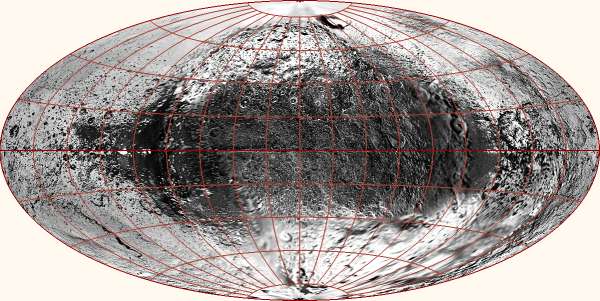
Now that I have a program to draw world maps with nonstandard orientations, I could not resist turning it loose on this albedo map of Saturn's moon Iapetus, pieced together from images taken by the Voyager 2 (1981) and Cassini (2005-2007) spacecraft. Iapetus is one of the strangest objects in the solar system. Its most famous feature is its "two-tone coloration": it has a light side and a dark side, and is much brighter when the light side faces the sun (and us). But there is more strangeness than that; go read the Wikipedia article.

In the novel version of 2001: A Space Odyssey, Author C. Clarke explained away all the strangeness with a deus ex machina solution: the entire moon is an alien artifact! He warned, however that "the truth, as always, will be far stranger."

Here is an ordinary map, with the central meridian chosen to go through the middle of the dark area:

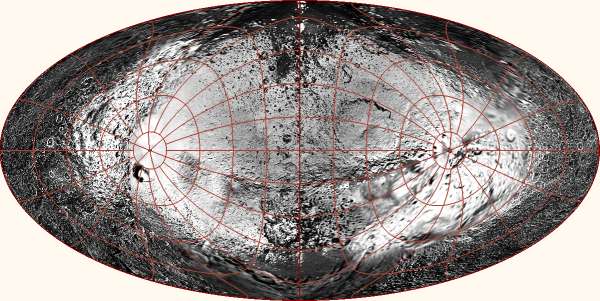
We see a large dark splotch (named Cassini Regio) on a light moon. On the other hand, Clarke relates in the introduction to 2010: Odyssey Two that Carl Sagan sent him a Voyager image showing a white oval on a dark moon. How can that be? Let's get out our planet tilter:

The edge of this map runs along the moon's equator, in the middle of Cassini Regio. Now we see a light splotch (called Roncevaux Terra) on a dark background. Magic!

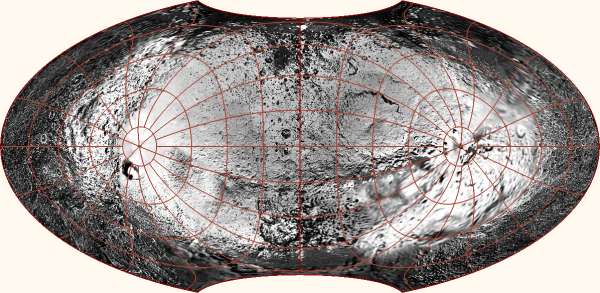
I've cheated a bit, though, by choosing the little-used Aitoff's projection for the above maps; it exaggerates the size of areas near the edge of the map. With the equal-area projection I used for Earth in my earlier post, the Roncevaux Terra map may begin to look more like a light world with a dark edge:

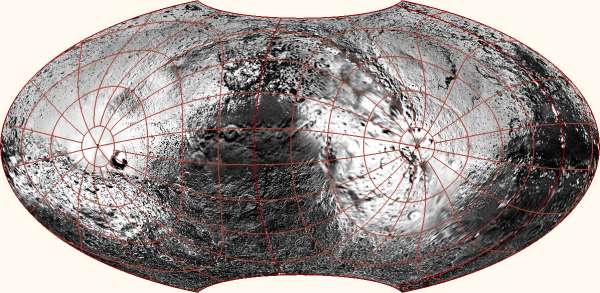
Finally, a map with the poles in the centers of the light/dark areas:

The boundary between light and dark does not really divide the moon into hemispheres; it goes more like the seam on a baseball.

2008-07-13

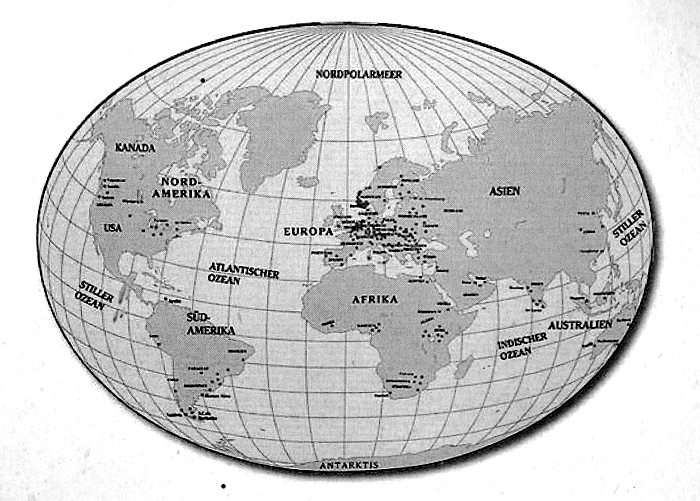
Cheap flights to Planet Barrel

Here is a poster I saw in the storefront of a travel agency in Frankfurt. I don't know which projection this world map tries to be, but if that isn't a barrel-shaped world it depicts, you can call me a barrel.